Collage
The Politics of Omission
AU$ 850 (Framed)
Fine Art print AU$ 145 (A1)
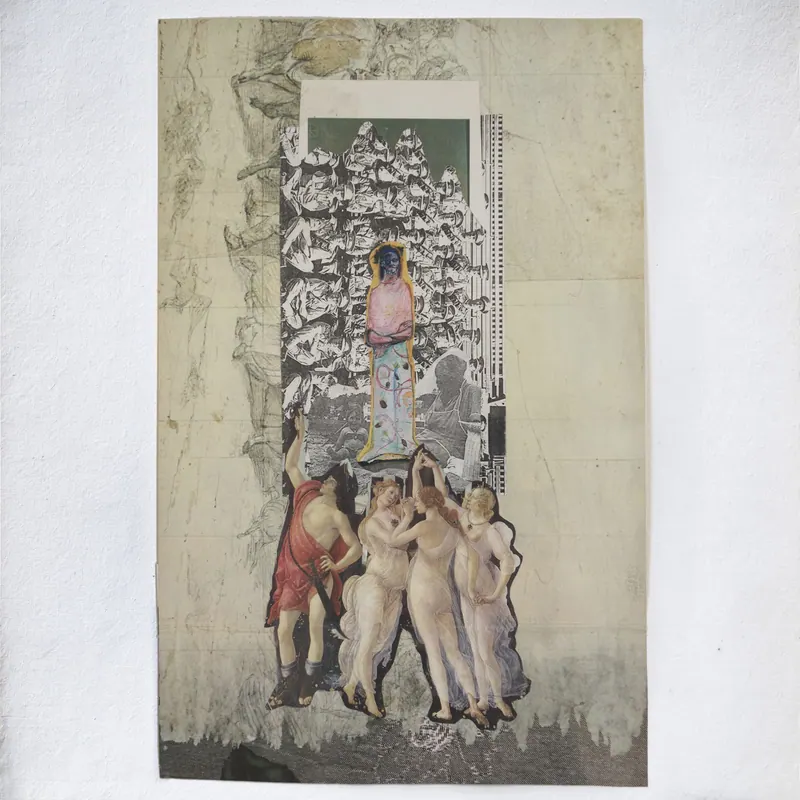
I made this collage after moving from South Africa to Australia, at a time when I was becoming increasingly aware of how little I knew about the history of my new home.
Growing up in South Africa, much of my education and cultural exposure had been shaped by European and American history. Through school, books, television and art, these distant places had become familiar to me, yet I arrived in Australia knowing remarkably little about its past. This absence of knowledge contributed to an unexpected sense of dislocation. I was living in a new country without the historical and cultural references that had previously helped me understand where I belonged.
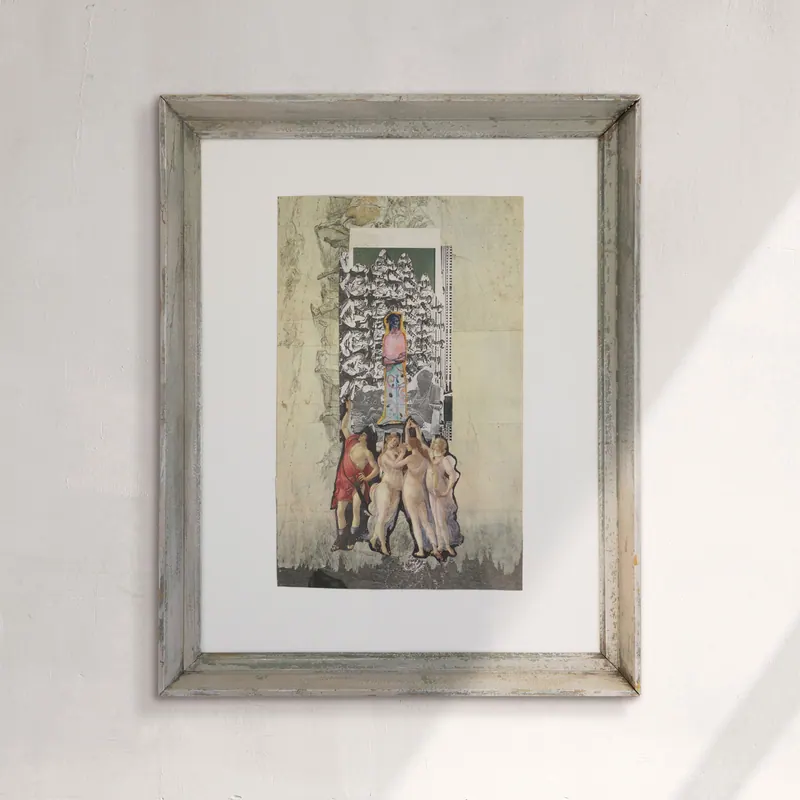
The collage brings together fragments of different histories, both public and personal. In the background is a historical image of the Australian military, overlaid with a black-and-white photograph of my grandfather during the World War. Above these is an image of my husband, Barry, as a young man, followed by a photograph of myself as a baby on a South African beach, a personal memory situated within the country's colonial history.
In the foreground, I placed figures from Botticelli's Primavera. I used them quite literally to represent three close friends I had left behind in South Africa, my relationship with Barry, and my enduring connection to art and the classical traditions that had shaped my visual education.
These images belong to different times, places and cultural histories, yet they coexist within the same space, much as they do in my own memory. Their overlapping and sometimes fragmented arrangement reflects the difficulty of reconciling an inherited past with the experience of beginning a life somewhere new.
There is also a feminist perspective within the work. The official histories of nations, wars and colonialism are placed alongside the quieter histories of women: friendship, family, love, motherhood and the experience of leaving one's home. These personal relationships are no less significant in shaping our understanding of who we are, even if they are largely absent from conventional historical narratives.
For me, the collage is as much about loss as it is about belonging. Migration involves more than leaving a physical place. It means leaving behind people, shared memories, familiar cultural references and a sense of continuity with one's own history.
Looking at this work today, against the backdrop of antisemitism and unrest in Melbourne, I am reminded of how profoundly selective histories can shape public attitudes. What we are taught, what is omitted and whose voices are given authority can influence how we understand others. When history is stripped of its complexity, prejudice can flourish, sometimes with devastating consequences.
The Politics of Omission attempts to bring these fragments together, not to resolve them into a single coherent narrative, but to question who controls the stories we inherit, whose experiences are excluded, and how those omissions continue to shape the world we live in.
- Year
- 2023
- Dimensions
- 620mm x 490mm
- Image credit
- © Shelly Lazar